War Simulator: World War 3 & Nuclear War Scenario Map
Mapdis War Simulator is a free, interactive nuclear war simulator and World War 3 scenario builder that models how a conflict between any two countries could escalate into global war based on real diplomatic alliances.
What would happen if two countries went to war today? Pick any attacker and defender, then watch as the rest of the world chooses sides. Based on real diplomatic relationships between nations, the map calculates how alliances would cascade, turning a regional dispute into a potential World War 3 scenario.
The simulator tracks nine nuclear-armed nations in real time. When any nuclear power's involvement score crosses the critical threshold of ±10, the scenario escalates into a nuclear war, the point at which a conventional conflict risks becoming an existential threat. Explore how quickly a border skirmish between two countries can pull the entire world toward the brink.
How It Works
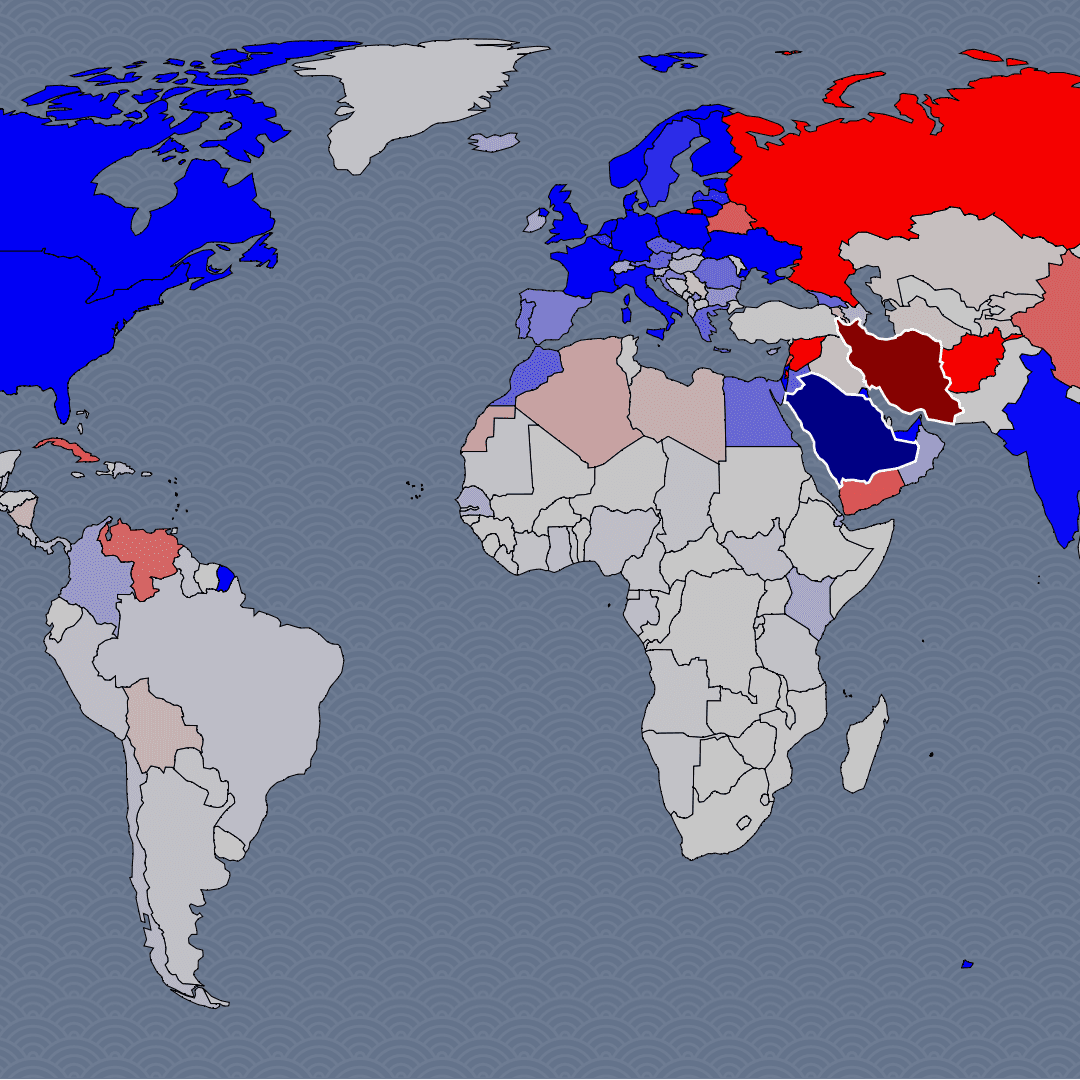
Choose a defender and an attacker to begin. Every other country starts undecided, then the simulator scores each nation based on its real-world relationships with both sides. Countries with strong ties to the defender drift blue; those aligned with the attacker drift red.
The model captures several dynamics that shape real conflicts: defenders attract stronger allied support than aggressors, nuclear powers carry more weight than conventional militaries, and being outnumbered amplifies a side's resolve. As you add more countries to either side, global amplification kicks in and each new participant pushes every other nation's score further from zero, reflecting how escalation feeds on itself.
Mark any country as Neutral to remove it from the scenario entirely. Use the Swap button to instantly reverse attacker and defender roles and see how the world responds differently.
The Nuclear War Threshold
The World War 3 tracker above the map monitors all nine nuclear-armed nations: the United States, Russia, China, the United Kingdom, France, India, Pakistan, Israel, and North Korea. Each country's score reflects how deeply it would be drawn into the conflict. When any nuclear power crosses ±10, the simulator flags a nuclear war scenario, the point where conventional warfare risks crossing into nuclear escalation. Full nuclear powers (the US, Russia, China, and the UK) exert significantly more gravitational pull on global alliances than regional nuclear states.
Country States
- Undecided (Variable): score determines color intensity
- Neutral (Dark Gray): excluded from the conflict
- Defender (Dark Blue): directly involved, defending side
- Attacker (Dark Red): directly involved, attacking side
Click any country on the map or use the search to cycle through states.
Popular World War 3 Scenarios
- USA vs Russia: a new Cold War gone hot, with NATO drawn in on one side and Russian allies on the other. One of the fastest paths to nuclear war.
- USA vs China: a Pacific theater conflict, likely over Taiwan, that pulls in regional powers across Asia and tests Western alliance commitments.
- Israel vs Iran: a Middle Eastern conflict that rapidly draws in Gulf states, Western powers, and Russia, with nuclear escalation risk from Israel’s arsenal.
- India vs Pakistan: two nuclear-armed neighbors whose conflict could escalate to nuclear war faster than any other regional scenario.
- China vs Taiwan: would the world intervene? See how alliance chains respond when China moves on Taiwan.
- Russia vs Ukraine: explore how the current conflict could widen if NATO countries were drawn in directly.
- North Korea vs South Korea: a Korean peninsula conflict that draws in the US, Japan, and China, with North Korea’s nuclear arsenal raising the stakes.
- Saudi Arabia vs Iran: a Gulf war scenario that splits the Middle East and pulls in global powers on both sides.
- Turkey vs Greece: two NATO allies in conflict, testing whether the alliance holds or fractures under internal tension.
- India vs China: the two most populous nations with a disputed border. See how South and East Asian alliances realign.
- USA vs North Korea: a strike on the Korean peninsula that risks pulling China and Russia into direct confrontation with the West.
- UK vs Argentina: a Falklands rematch. Would NATO back the UK? Would South America rally behind Argentina?
- Japan vs China: an East China Sea dispute that tests the US-Japan security treaty and reshapes Pacific alliances.
- Israel vs Palestine: see how the world divides when the Israeli-Palestinian conflict escalates to full war.
- Egypt vs Ethiopia: a Nile water crisis turned military, with the African Union and Middle Eastern powers choosing sides.
- NATO vs Russia: the full Western alliance against Russia. Add multiple NATO members as defenders and watch how Russia's allies respond.
Use the preset dropdown to quickly load these World War 3 and nuclear war scenarios, or build your own.
Frequently Asked Questions
- What is a war simulator?
- A war simulator models how a military conflict between two or more countries could play out based on real-world alliances and diplomatic relationships. This simulator focuses on alliance cascades: when one country attacks another, which nations would join each side, and how quickly a regional war could escalate into a global conflict.
- How does this World War 3 simulator work?
- You choose an attacker and a defender. The simulator then scores every other country based on its diplomatic relationships with both sides. Countries closely allied with the defender drift toward blue, while those aligned with the attacker drift toward red. As more nations join either side, escalation amplifies and scores rise. When any nuclear power's score reaches ±10, the scenario crosses into nuclear war territory.
- Which countries have nuclear weapons?
- Nine countries currently possess nuclear weapons: the United States, Russia, China, the United Kingdom, France, India, Pakistan, Israel, and North Korea. The simulator tracks all nine and weights their influence based on the size and reach of their arsenals. The US, Russia, China, and the UK are treated as full nuclear powers, while France, India, Pakistan, Israel, and North Korea are weighted as regional nuclear states.
- What would happen if the US and Russia went to war?
- A US vs Russia conflict is one of the most dangerous scenarios in the simulator. NATO allies quickly rally behind the US as defender, while Russian allies like Belarus, China, and North Korea join the opposing side. Because both the US and Russia are full nuclear powers, scores escalate rapidly and the nuclear war threshold is crossed almost immediately. Try the USA vs Russia preset to see the full alliance cascade.
- Would World War 3 go nuclear?
- It depends on who is involved. The simulator shows that conflicts between major nuclear powers (US, Russia, China) cross the nuclear threshold almost immediately due to the strength of their alliances. Conflicts between smaller nations can remain conventional unless they pull in enough nuclear-armed allies to push scores past ±10. The World War 3 tracker above the map shows exactly how close each nuclear power is to that line.
- What countries would be allies in World War 3?
- Alliance patterns depend heavily on who starts the conflict. Generally, NATO countries (the US, UK, France, Germany, and others) tend to align together, while Russia, China, Iran, and North Korea often end up on the same side. But the simulator shows that the specific attacker and defender pairing matters enormously. Try swapping the roles to see how alliances shift when the aggressor changes.
- Does the simulator use real data?
- It uses AI-generated scores from the latest Google Gemini models. Every country pair (over 20,000 pairs) is scored across five dimensions — military, economic, diplomatic, governmental, and cultural — six times each: three regular runs and three runs with recent news updates. The results are averaged. The data comes from AI evaluation rather than raw statistics, but this approach captures the full picture of how two countries relate better than any single source like UN voting records or trade figures alone.
- Can I simulate a war between any two countries?
- Yes. Click any country on the map or use the search box to select it. The first click assigns a country as a defender (blue), and you can add attackers (red) and additional countries to either side. You can also mark countries as neutral to exclude them from the scenario entirely.