Geopolitical Conflict Simulator: Who Would Side With Who?
Build hypothetical conflict scenarios and see how 203 countries would align. Place nations on opposing sides, then watch the rest of the world choose based on real diplomatic, military, and economic relationships.
If the US and China went to war over Taiwan, who would join each side? Would Southeast Asian nations follow their security alliances or their trade dependencies? What happens when you add Japan to the US side — does that push South Korea closer or make it more cautious? This simulator answers these questions using scored relationships between every country pair across six dimensions of international relations.
Unlike the War Simulator, which models escalation dynamics and nuclear thresholds, the Conflict page focuses on alignment prediction. Every undecided country receives a score based on how its relationships with each side compare, and the map colors accordingly. Add countries to either side and watch how each addition cascades through the global alliance network.
How It Works
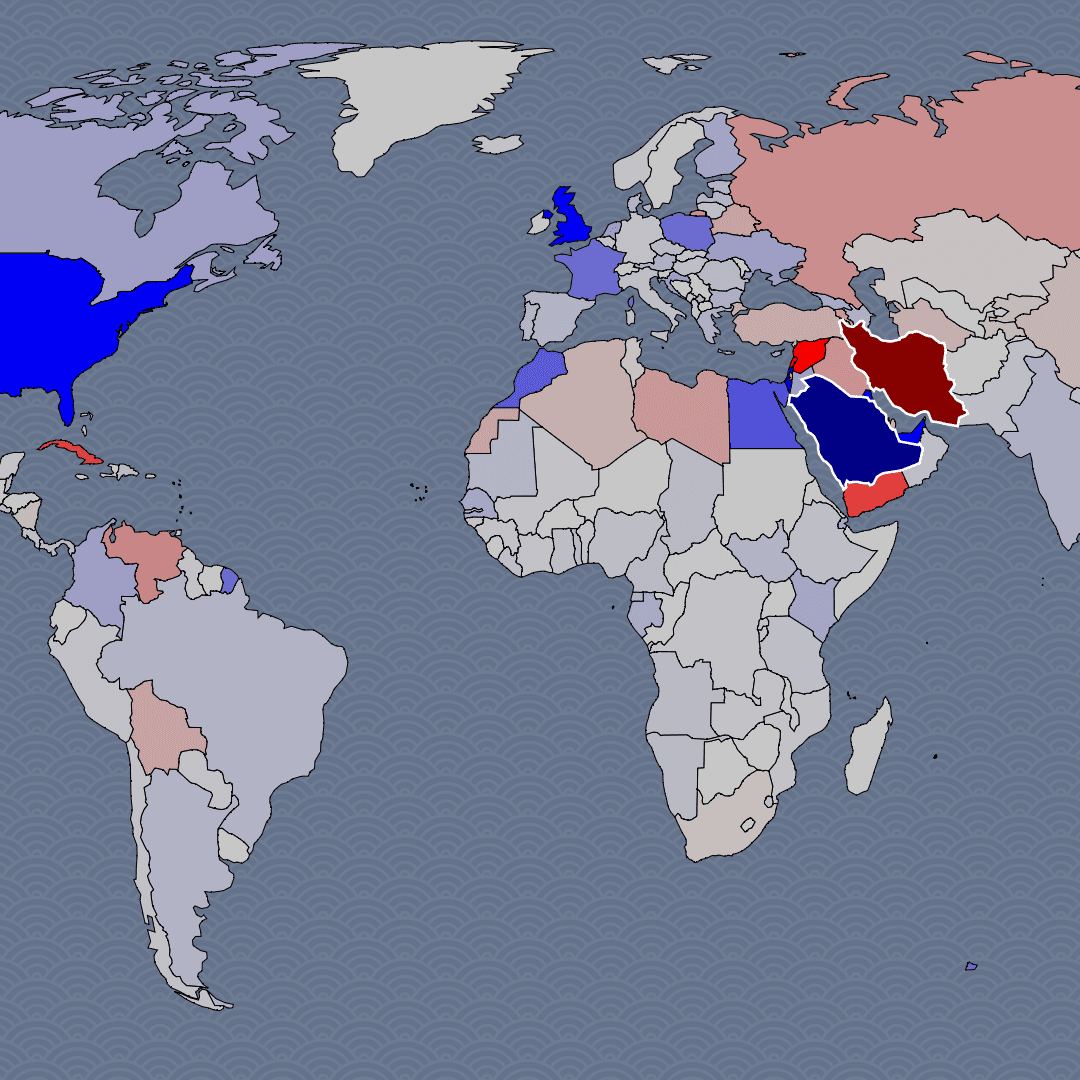
Assign countries to the Blue side or the Red side. Once both sides have at least one country, the simulator scores every remaining nation based on its relationships with both sides. Countries with stronger ties to Blue drift blue; those closer to Red drift red.
The key insight is that adding more countries to either side changes the entire map. When Japan joins the Blue side in a US-China scenario, South Korea and Australia shift further blue, but some Southeast Asian nations actually become more neutral as competing pressures cancel out. Every addition creates a ripple effect.
Use the Dimension button to switch between military, diplomatic, regime, societal, and economic lenses. A country that's a strong military ally might be an economic competitor, and the conflict map makes these contradictions visible.
Three-Way Conflicts
Most geopolitical tools model conflicts as binary, but real-world power dynamics are often triangular. Toggle 3-Side mode to add a third Green side and see how countries split when three powers compete simultaneously. Each nation gets scored against all three sides, producing a percentage breakdown that shows where its loyalties actually lie.
Three-way mode is especially revealing for scenarios like US vs China vs EU, where the assumption of a unified "Western" bloc breaks down, or India vs China vs Pakistan, where South Asian triangular dynamics become visible. Countries you expected to pick a side often show surprisingly balanced pulls in multiple directions.
Country States
- Undecided (Variable): color intensity shows predicted alignment strength
- Neutral (Dark Gray): explicitly excluded from the scenario
- Side A (Dark Blue): assigned to the blue coalition
- Side B (Dark Red): assigned to the red coalition
- Side C (Green): third coalition, available in 3-Side mode
Click any country on the map to cycle through states, or use Search to find it by name.
Conflict Scenarios to Explore
- USA vs China: the defining great-power rivalry. A conflict likely sparked over Taiwan splits Asia: Japan and Australia back the US, while Pakistan and North Korea lean toward China. Southeast Asian nations face an impossible choice between their security guarantor and their largest trading partner.
- USA vs Russia: NATO rallies to one side, but the map reveals which nations stay neutral and who quietly aligns with Moscow. Middle Eastern and African countries split in ways that reflect decades of arms deals and competing diplomatic investments.
- USA vs Iran: a Persian Gulf crisis that tests whether the Middle East breaks along predictable lines. Saudi Arabia and Israel find themselves on the same side, a rare alignment that reveals the region's shifting power dynamics.
- Israel vs Iran: the shadow war made open. Gulf states, Western powers, and Russia all get pulled in. Switch between military and diplomatic dimensions to see how differently each lens predicts global alignment.
- Israel vs Palestine: the most globally polarizing scenario. The map reveals a sharp divide between Western nations and much of the Global South. Dimension switching shows how military backing diverges from diplomatic sympathy.
- China vs Taiwan: would the world actually intervene? Military alliances suggest strong support for Taiwan, but economic dependencies tell a different story. Switch dimensions to see the gap between security commitments and trade realities.
- China vs India: the two most populous nations with a disputed Himalayan border. South and East Asian alliances realign, and Russia faces the uncomfortable position of having deep ties to both sides.
- Russia vs Ukraine: the active conflict modeled through alliance prediction. See which nations back Ukraine beyond public statements and which maintain quiet ties to Moscow across different dimensions.
- India vs Pakistan: two nuclear-armed neighbors whose rivalry reshapes South Asian alignments. China's position shifts depending on whether you examine military, diplomatic, or economic dimensions.
- Saudi Arabia vs Iran: the Gulf's great sectarian and geopolitical rivalry. The map splits the Middle East along fault lines that cut across economic partnerships and draw in outside powers on both sides.
- Turkey vs Greece: two NATO allies on opposite sides. Does institutional membership trump regional rivalry? The map tests whether alliance frameworks hold when members turn on each other.
- Armenia vs Azerbaijan: a Caucasus conflict that draws in Turkey, Russia, and Iran in overlapping and contradictory ways. One of the clearest examples of how regional conflicts create strange bedfellows.
- North Korea vs South Korea: a frozen conflict that could unfreeze. The US, Japan, and China are pulled in immediately, and the map shows how the rest of Asia and beyond would divide.
- Ethiopia vs Egypt: the Nile water dispute turned military. African Union members split, Middle Eastern powers take sides, and the map reveals a conflict dynamic that most global analyses overlook.
Load any of these from the Presets menu, or build your own scenario from scratch.
Three-Way Scenarios
- USA vs Russia vs China: the three great powers, each against both others. Reveals which countries are genuinely non-aligned and which are caught between competing pulls.
- USA vs China vs EU: what happens when the Western alliance fractures? European and American interests diverge, and the rest of the world recalculates.
- Israel vs Iran vs Saudi Arabia: three Middle Eastern powers competing simultaneously. Shows the region's real tripartite power structure beyond the usual binary framing.
- India vs China vs Pakistan: South Asia's triangular rivalry. Each side pulls different neighbors in different directions, and no country in the region can stay fully neutral.
Enable 3-Side mode and use the presets menu to load these scenarios.
Frequently Asked Questions
- What is a geopolitical conflict simulator?
- A conflict simulator models how countries would align if two or more nations found themselves on opposing sides of a dispute. Rather than predicting whether a conflict will happen, it answers the question "who would side with who?" based on real diplomatic, military, economic, and societal relationships between nations.
- How are alliance predictions calculated?
- Each undecided country is scored based on its relationships with every country on both sides. If a nation has strong military ties with the Blue side and weak ties with the Red side, it drifts blue. The prediction uses a 203-country relationship matrix scored by AI across six dimensions, with each country pair evaluated multiple times for accuracy.
- What is 3-Side mode?
- 3-Side mode adds a third faction (Green) to the conflict, allowing you to model triangular power dynamics. Instead of a binary blue-vs-red split, each country gets a percentage breakdown showing how it would distribute its alignment across three competing sides. This reveals which countries are genuinely non-aligned versus which are being pulled in multiple directions.
- What's the difference between the Conflict and War pages?
- The Conflict page focuses on alliance prediction: who would side with who in any hypothetical scenario, with support for three-way conflicts and dimension switching. The War Simulator adds escalation dynamics, including nuclear threshold tracking for nine nuclear-armed nations, attacker/defender asymmetry, and snowball effects where each new participant amplifies the entire scenario.
- Why do alliances change when I switch dimensions?
- Because military allies are not always economic partners, and diplomatic engagement does not always reflect ideological alignment. For example, in a US-China scenario, switching from the military dimension to trade reveals that many countries with US security ties are deeply economically dependent on China. The dimension selector exposes these contradictions that a single blended score would hide.
- Who would side with China in a US-China conflict?
- It depends on the dimension. Militarily, Russia, Pakistan, and North Korea show the strongest alignment with China. Diplomatically, China has broader support across Africa and parts of Southeast Asia through trade and infrastructure investment. Economically, many US-aligned nations show significant ties to China, reflecting the tension between security alliances and trade dependencies. Try the USA vs China preset and switch dimensions to see the full picture.
- Can I add multiple countries to each side?
- Yes. Click any country to assign it to a side. You can build coalitions of any size, like placing all NATO members on the Blue side and seeing which non-aligned nations drift toward each coalition. Each addition changes the entire map, since every undecided country recalculates its alignment based on the full set of countries on both sides.
- Does the simulator use real data?
- The underlying relationship matrix is built from AI evaluations of every country pair across six dimensions: military, diplomatic, regime relations, societal ties, trade interdependence, and economic policy. Each pair is scored multiple times with different model configurations, including news-grounded runs that incorporate recent geopolitical events. The scores are averaged to produce the relationship values used for alliance prediction.